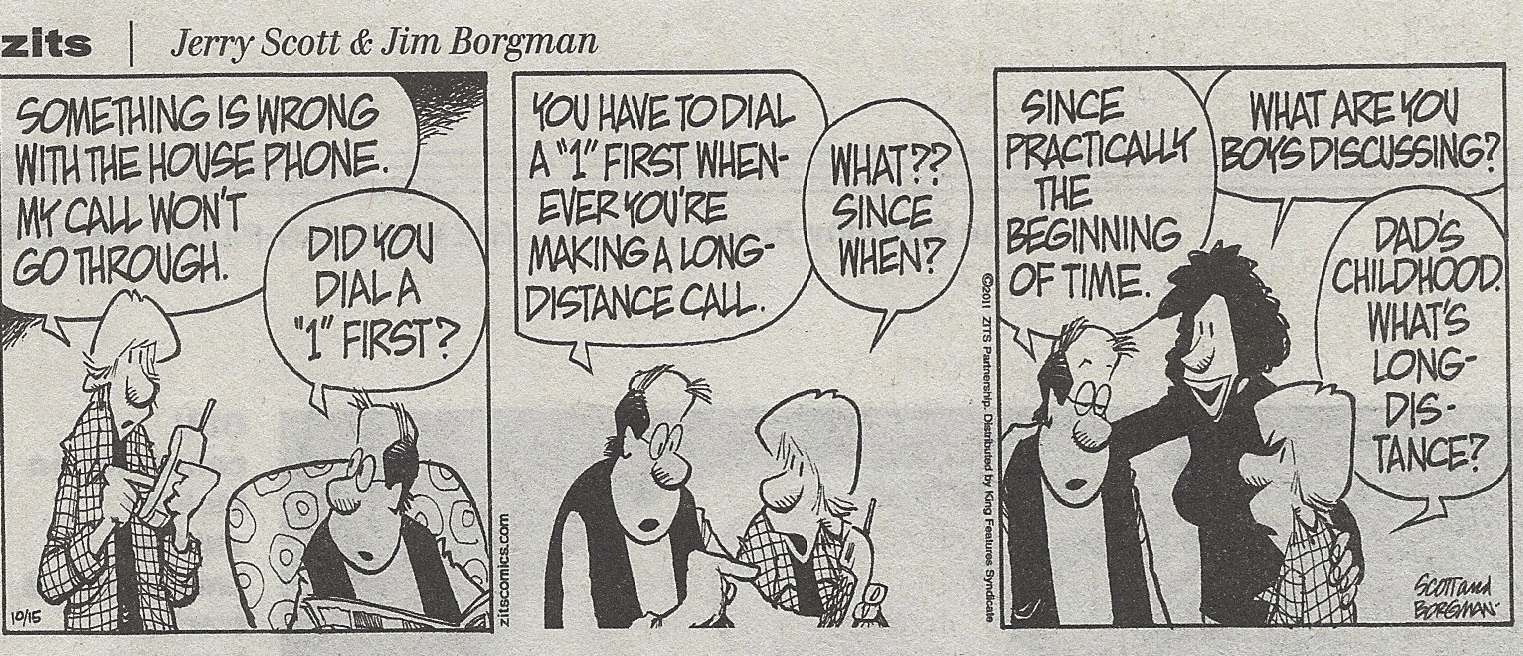
Every morning when the newspaper comes, my dear husband always hands me the most important section first: the comics. One of my favorite comic strips is one called Zits, about the life and trials of raising a teenage boy. A couple of days ago, the teenager’s father asked him if he had seen the Yellow Pages, and the boy replied, “Not since I sat on it in my highchair.” I used to always look in the Yellow Pages if I needed to look up the phone number of a business. Now, however, I find it easier to look it up on the computer. Today’s youth, though, probably have never used the Yellow Pages. Then a couple of days ago, I saw this Zits strip:

Most kids these days have always used cell phones. Many homes don’t even have land lines anymore, so how would kids know about dialing “1” before calling out of their area code, or know what long distance meant?
This made me think about a book I read many years ago, Cultural Literacy, by E.D. Hirsch. Hirsch talks about the body of knowledge that all Americans should know in order to understand what they read and to effectively communicate with one another. He advocated that this core knowledge be taught in schools because students who did not have this knowledge were at a disadvantage in literacy.
For example, when we read about somebody who is a scrooge, we know that refers to a person who is miserly or tight-fisted. How do we know this? Because nary an American doesn’t have some connection to Dickens’s A Christmas Carol in some form or another and know what kind of a man Ebenezer Scrooge is. If they haven’t read the actual story, they have seen one of the many film adaptations of it. From studying mythology, a person would know why Atlas Tires is a good name for a company who wants to project the image that they can carry you safely on any trip you take in your car. That person would also know that you were speaking of someone’s weakness when you mentioned his or her Achilles tendon.
The recent Zits comic strips brought to mind that this body of core knowledge is constantly changing. New words are periodically being added to the dictionary as technology advances and cultural and world situations change. A few recent additions to the dictionary are the following words: tweet, bromance, sexting, flash mob, vlog, Bollywood, and fist bump. Many older people have no frame of reference for these words, just as many younger people wouldn’t know what the Yellow Pages are for.
I don’t know how you keep it all straight! Kids these days speak a language I don’t understand, and no amount of my “core knowledge” has prepared me for it. While surfing on the web this morning, I came across a site that offered free online tests of cultural literacy. They were entertaining, and I did quite well on every one I’ve taken so far. I wonder how many of today’s young people can score as well as I did. Yet, how well does my grasp of those facts help me to function in today’s fast-changing world? Not very, I’m guessing.
You can’t teach a child, or anybody for that matter, everything, so obviously, you have to pick and choose what’s important to know. How do you know what to leave out in order to include what’s new? Are different generations having trouble communicating with each other since each has a different set of core knowledge? I’m certainly willing to learn new things and incorporate them into my frame of reference, but I hope the younger generation is, too, because certain knowledge is too precious to lose. I’m dreading the day when my youngest grandchild says to me, “Clark Kent changed into his Superman costume in a what?”


















 Coming East